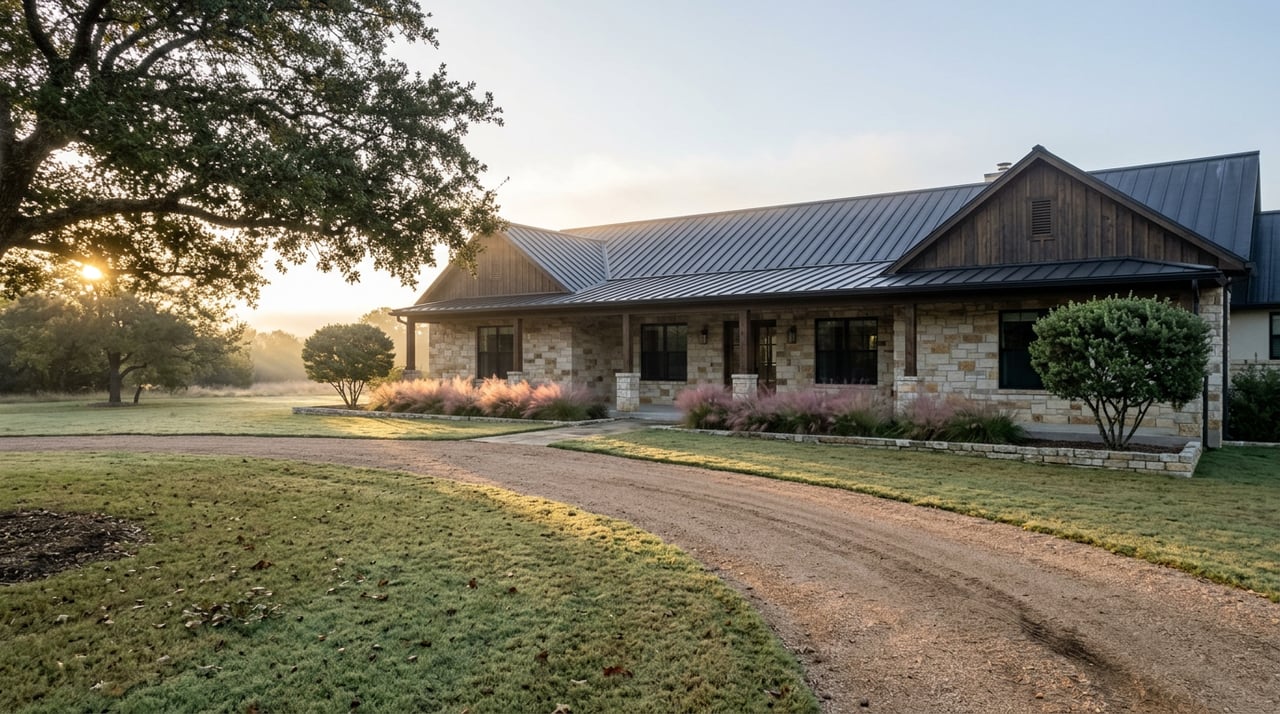
Two houses sit less than a quarter mile apart on Wortham Bend Road. Same school zoning. Same rolling pasture views. Same general asking price range for the area. But on one recent day, only one of them was legally forbidden from watering a lawn, filling a pool, or washing a truck in the driveway. The other, sitting just outside a boundary line that shows up on no listing sheet anywhere, went on with its week unaffected.
That line is not the China Spring ISD boundary, the one most buyers spend their energy researching. It is a water utility boundary, and in China Spring there are three of them, drawn decades apart by three separate member-owned cooperatives that have nothing to do with each other. If you are comparing a China Spring property to something in Hewitt or Woodway, this is the fact the median price on the portal will never tell you: the school district drew the map you searched by, but the water company draws the map you actually live inside.
The Map You Searched By Isn't the Map That Governs You
China Spring has no city hall. It is an unincorporated community, a census-designated place in McLennan County, and the thing that gives it civic shape is the school district rather than a municipal government. That single fact explains almost everything else about how utilities got built here. Where a city would have run one water system out from a central plant decades ago, China Spring's growth happened lot by lot, ranch by ranch, with rural cooperatives stringing pipe to whichever cluster of new rooftops needed it next. Nobody planned one system for the whole area, because there was no single authority to plan it.
The result is a patchwork that has nothing to do with how the community feels on the ground. Two subdivisions can share a fence line and answer to entirely different water providers, each with its own capacity, its own pressure, its own board of directors, and its own rules for what happens when supply gets tight.
Three Companies, No City Hall
If you're evaluating a specific address in China Spring, the water provider serving it is one of a small number of cooperatives, most commonly:
- Cross Country Water Supply Corporation, based on Wortham Bend Road, serving a wide swath of the northern and western parts of the community
- Highland Park Water Corporation, a separate member-owned system with its own service territory
- Community Water Supply Corporation, another distinct cooperative operating under its own board
Each one runs as its own utility. Rate structures differ. Drought contingency plans differ. And because each system draws from its own wells, a mechanical failure at one company's site has zero bearing on a house served by a different provider three streets over.
That is not a hypothetical. Cross Country Water Supply Corporation has posted a notice moving to Tier 3 of its drought contingency plan after a mechanical failure at one of its well sites, banning all outdoor water use except for livestock across a named list of streets that included Wortham Bend, Childress Creek Drive, Garrett Lane, Talbert Ranch Road, Sonoma Ridge, and the Hills of Childress Creek subdivision. A house served by Highland Park or Community was never part of that notice. Same community, same school district, a completely different reality on those specific streets.
What Happens Underground Matters Just As Much
Water coming in is half the story. What happens to it on the way out is the other half, and in China Spring that mostly means septic rather than sewer.
The terrain here sits where the blackland prairie thins out and a limestone shelf starts pushing close to the surface, and that shelf is inconsistent lot to lot. Perc tests, the soil tests that determine whether a standard septic drainfield will work, come back marginal in some spots and fine in others immediately next door. One lot supports a conventional system without issue. Its neighbor needs an aerobic system instead, because the soil at that specific depth won't move water fast enough. McLennan County handles the permitting, and TCEQ's Chapter 285 rules for onsite sewage set the baseline every design has to meet, but the baseline still leaves real variation between individual parcels.
This matters most on older properties, where a septic system installed decades ago on a working farm may be functioning fine but carries no clear service history. A real estate inspection that reports a system as functional is not the same as knowing when it was last pumped or whether the original design still matches how the household actually uses water today. On newer construction, where subdivisions that were raw acreage a few years ago now have homes on systems built to current spec, this is less of a concern. On anything older, it is worth a direct conversation before the option period closes.
The Acreage Buyer's Blind Spot
China Spring's current land inventory leans heavily toward larger tracts. Listings in the 20 to 45 acre range are common right now, marketed with language about open layouts, creek frontage, and room to build. Buyers looking at this kind of acreage sometimes assume that owning enough land automatically means independence from the local water cooperative and the freedom to drill a private well without restriction.
Texas law does allow something like that, but the rule is narrower than it sounds. Under the Texas Water Code, a landowner with at least 25 contiguous acres inside a utility's certificated service area can petition to exclude some or all of that property from the utility's territory, as long as the land is not already receiving retail water or sewer service. That last condition is the one that trips people up. Several of the larger tracts currently listed in China Spring already show a reserved or installed water meter as a selling point, which is a convenience for a future buyer but also means that specific parcel may no longer qualify for the opt-out, since it is already tied into service. A 30 acre tract with no meter and a 30 acre tract with a meter already run to the property line can sit under completely different rules, even if they're advertised almost identically.
What This Means When You're Comparing Two Listings
None of this shows up on a standard listing sheet, and none of it will surface in a portal search filtered by price and acreage. It surfaces during due diligence, which means the buyer who asks these questions early has real leverage over the one who finds out during the option period.
Before writing an offer on a China Spring property, it's worth confirming:
- Which water provider actually serves the address, not just the general area
- Whether that provider has an active or recent drought contingency notice affecting the property's street
- Whether the property is on septic or sewer, and if septic, when the system was last inspected and pumped
- For larger acreage tracts, whether a water meter has already been installed or reserved, since that affects eligibility for the CCN opt-out
A home's price tells you what a buyer paid. It does not tell you which of three water companies will answer the phone when something goes wrong, or whether the ground under the backyard will accept a standard drainfield. Those are the details that decide whether ownership here feels straightforward or complicated, and they are worth settling before the earnest money moves.
A Few Questions Worth Asking Early
How do I find out which water company serves a specific China Spring address? The property's current water bill or the seller's disclosure will name the provider. If neither is available yet, the Public Utility Commission of Texas maintains a CCN viewer that shows certificated service area boundaries by location.
Does a private well mean no ongoing water bill? Not automatically. A private well still requires maintenance, periodic water quality testing, and eventually pump replacement, so it trades a monthly utility bill for occasional larger costs rather than eliminating costs altogether.
If a septic system passes inspection, is that the end of the conversation? A passing inspection confirms the system is functioning at that moment. It does not confirm pump history or design capacity for a different household's water use, which is why asking directly about maintenance records is worth the extra step.
China Spring rewards buyers who look past the school district line and ask what's actually running underground and overhead on a specific address. If you're comparing a property here against something in Woodway, Hewitt, or Robinson and want a straight answer about what a specific street's utility situation looks like, Brook Ashley Dowd can walk through it with you. Let's Connect.
